How PAYE Tax is Calculated on Your Payslip in the UK 2026
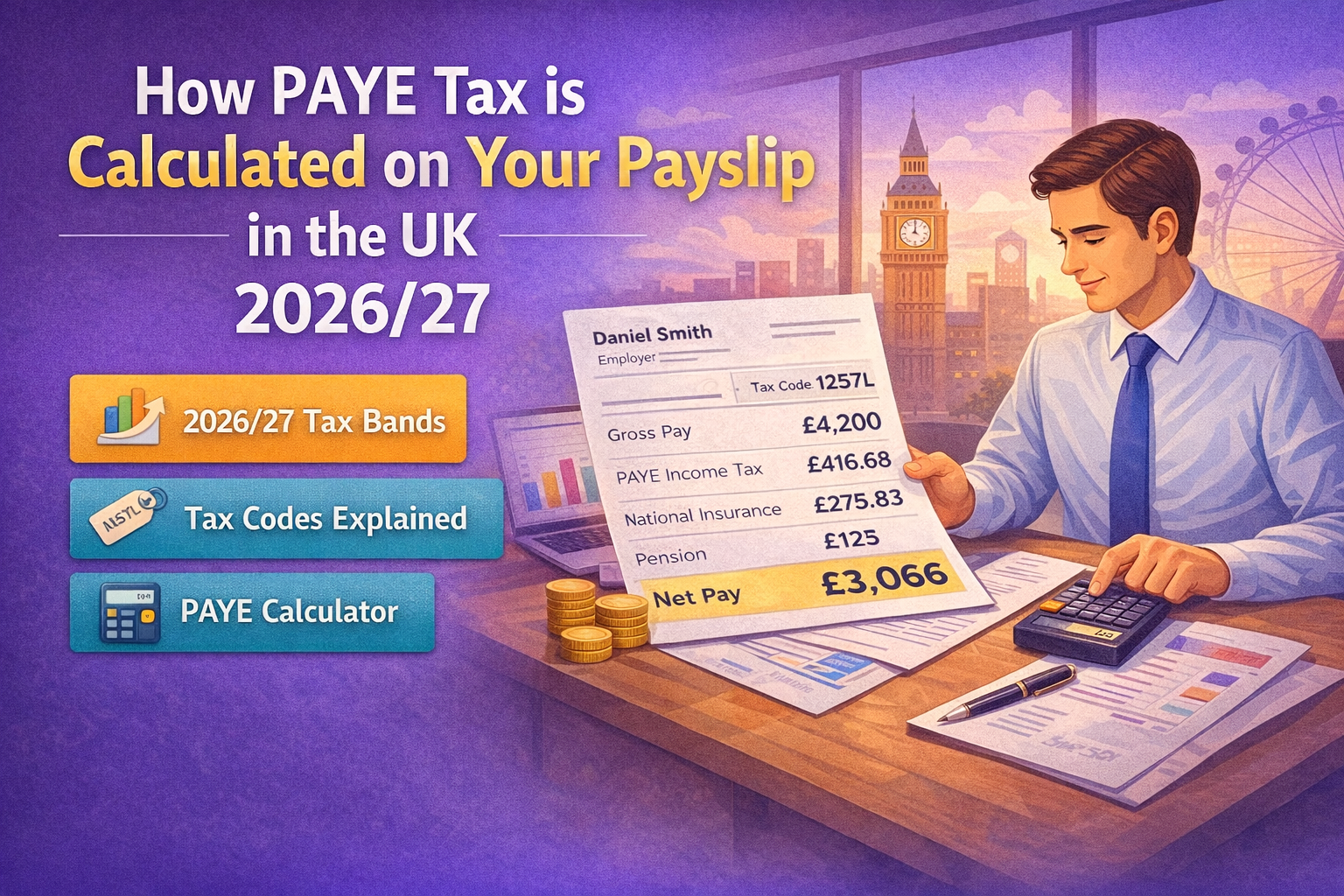
Ever wondered where your money actually goes? Your payslip shows gross pay, then a chunk disappears before you see net pay. Understanding how PAYE (Pay As You Earn) tax is calculated helps you verify you’re paying the correct amount, spot errors, and plan your finances accurately. In the 2026/27 tax year, the UK Income Tax personal allowance remains at £12,570, with three tax bands above that threshold. This guide breaks down exactly how your employer calculates the deductions on every payslip.
What is PAYE Tax?
PAYE stands for Pay As You Earn, the system HMRC uses to collect Income Tax and National Insurance from employees. Rather than waiting until the end of the tax year to send you a bill, your employer deducts these taxes from your wages before you receive them.
This system has two major advantages. First, spreading tax payments across the year makes them manageable rather than facing a large lump sum. Second, HMRC receives tax revenue continuously throughout the year, which helps fund public services.
Who Pays PAYE?
If you’re an employee receiving a wage or salary through payroll, you pay PAYE. This includes full-time, part-time, and temporary workers. Your employer acts as a tax collector, calculating what you owe and sending it directly to HMRC on your behalf.
Self-employed people don’t use PAYE. Instead, they complete Self Assessment tax returns and pay tax directly to HMRC. If you have both employed and self-employed income, you’ll pay PAYE on your salary and Self Assessment on your business earnings.
Employers are legally required to operate PAYE correctly. If they make mistakes that result in you underpaying tax, HMRC usually pursues you for the shortfall, not your employer. This makes understanding your payslip crucial for catching errors early.
Understanding Your Payslip: Key Terms
Before we get into calculations, you need to understand the basic structure of a UK payslip. Every payslip must legally contain specific information.
Mandatory Payslip Information
Gross Pay
Your total earnings before any deductions. This includes your basic salary, overtime, bonuses, and commission.
Net Pay (Take-Home Pay)
The amount that actually hits your bank account after all deductions. This is gross pay minus tax, National Insurance, pension contributions, and any other deductions.
Variable Deductions
Amounts that change from month to month. This includes Income Tax and National Insurance, which vary based on how much you earn.
Fixed Deductions
Regular deductions that stay the same, such as trade union subscriptions or charitable giving through payroll.
Additional Information Usually Shown
- Tax period (the specific pay period covered)
- Tax code (we’ll explain this shortly)
- National Insurance number
- Year-to-date figures (totals since the tax year began on 6 April)
- Employee and employer pension contributions
- Holiday accrual or remaining balance
Store your payslips securely for at least six years. You’ll need them for mortgage applications, loan requests, proof of income for benefits, checking your tax is correct, and resolving disputes with your employer or HMRC.
UK Income Tax Bands for 2026/27
Income Tax in the UK operates through a system of bands. You pay different rates on different portions of your income, not a single rate on everything you earn.
England, Wales, and Northern Ireland
For the 2026/27 tax year (6 April 2026 to 5 April 2027), these tax bands apply:
| Tax Band | Annual Income | Tax Rate |
|---|---|---|
| Personal Allowance | Up to £12,570 | 0% |
| Basic Rate | £12,571 to £50,270 | 20% |
| Higher Rate | £50,271 to £125,140 | 40% |
| Additional Rate | Over £125,140 | 45% |
Scotland
Scotland has devolved tax powers, creating different rates and bands. For 2026/27, Scottish taxpayers face these rates:
| Tax Band | Annual Income | Tax Rate |
|---|---|---|
| Personal Allowance | Up to £12,570 | 0% |
| Starter Rate | £12,571 to £15,397 | 19% |
| Basic Rate | £15,398 to £27,491 | 20% |
| Intermediate Rate | £27,492 to £43,662 | 21% |
| Higher Rate | £43,663 to £75,000 | 42% |
| Advanced Rate | £75,001 to £125,140 | 45% |
| Top Rate | Over £125,140 | 48% |
The Personal Allowance Taper
There’s a hidden trap for high earners. Once your income exceeds £100,000, you lose £1 of personal allowance for every £2 earned above this threshold. This creates an effective tax rate of 60% on income between £100,000 and £125,140.
By the time your income reaches £125,140, your personal allowance disappears completely, meaning all your income is taxable.
How the 60% Tax Trap Works
Earn £110,000:
Personal allowance reduced by: £10,000 ÷ 2 = £5,000
Remaining personal allowance: £12,570 – £5,000 = £7,570
The £5,000 of previously tax-free income now gets taxed at 40%, effectively adding 20% tax on top of the normal 40% rate on the income above £100,000.
How Tax Codes Work
Your tax code tells your employer how much tax-free income you’re entitled to. It appears on your payslip and determines how much tax gets deducted each pay period.
Understanding the Most Common Code: 1257L
For 2026/27, most people have tax code 1257L. Here’s what it means:
- 1257: Your personal allowance is £12,570 (the numbers represent this with the last digit removed)
- L: You’re entitled to the standard tax-free personal allowance
Your employer divides your personal allowance equally across your pay periods. If you’re paid monthly, you get £1,047.50 tax-free each month (£12,570 ÷ 12).
Other Common Tax Code Letters
BR (Basic Rate)
All your income from this job is taxed at 20%. Usually applied to second jobs where your personal allowance is used against your main employment.
D0 (Higher Rate)
All income taxed at 40%. Often used for second jobs when your main job already uses your personal allowance and pushes you into the higher rate band.
NT (No Tax)
No tax deducted. Rare and usually means you’re earning below the personal allowance across all jobs.
K Code
You owe more tax than your personal allowance covers, often because of benefits in kind or pension drawdown. The K code adds extra taxable income to your pay rather than giving an allowance.
M and N Codes
Marriage Allowance codes. If your spouse or civil partner doesn’t use their full personal allowance, they can transfer some to you (N code), and they receive an M code.
HMRC sends a coding notice when your tax code changes. If it looks wrong (for example, you’re on BR but only have one job), contact HMRC immediately. Wrong codes mean wrong tax deductions, which you’ll need to reclaim later.
🔍 Check Your Tax Code is Correct
Our free UK tax code checker explains what your code means and helps you identify if HMRC has made an error that’s costing you money.
Check Your Tax Code →Calculating Your Income Tax
Now let’s work through how your employer actually calculates the Income Tax deducted from each payslip.
The Basic Formula
Income Tax is calculated on your taxable income, which is gross pay minus your tax-free allowance for that pay period.
Monthly Income Tax Calculation
Step 1: Calculate tax-free income for the month
£12,570 ÷ 12 = £1,047.50
Step 2: Calculate taxable income
Step 3: Apply tax rates to each band
💼 Example: Sarah’s Monthly Tax
Annual salary: £35,000
Monthly gross pay: £35,000 ÷ 12 = £2,916.67
Tax code: 1257L
Calculation:
Tax-free monthly allowance: £12,570 ÷ 12 = £1,047.50
Taxable income: £2,916.67 – £1,047.50 = £1,869.17
All of Sarah’s taxable income falls in the basic rate band (20%):
£1,869.17 × 20% = £373.83 Income Tax per month
Annual tax: £373.83 × 12 = £4,485.96
💼 Example: James’s Higher Rate Tax
Annual salary: £65,000
Monthly gross pay: £65,000 ÷ 12 = £5,416.67
Tax code: 1257L
Calculation:
Tax-free monthly allowance: £1,047.50
Taxable income: £5,416.67 – £1,047.50 = £4,369.17
James’s income spans two tax bands. First, calculate the basic rate band monthly limit:
Basic rate band: £12,571 to £50,270 = £37,700 taxable
Monthly basic rate limit: £37,700 ÷ 12 = £3,141.67
Tax calculation:
Basic rate (20%): £3,141.67 × 20% = £628.33
Higher rate (40%): (£4,369.17 – £3,141.67) × 40% = £491.00
Total monthly tax: £628.33 + £491.00 = £1,119.33
National Insurance Contributions Explained
National Insurance (NI) is a separate deduction from Income Tax, though it appears alongside tax on your payslip. NI funds state benefits including the State Pension, NHS, and unemployment benefits.
Employee National Insurance Rates 2026/27
Employees pay two rates of NI depending on earnings:
| Earnings Band | Weekly | Monthly | Annual | NI Rate |
|---|---|---|---|---|
| Below Primary Threshold | Up to £242 | Up to £1,048 | Up to £12,570 | 0% |
| Primary Threshold to Upper Earnings Limit | £242.01 to £967 | £1,048.01 to £4,189 | £12,571 to £50,270 | 8% |
| Above Upper Earnings Limit | Over £967 | Over £4,189 | Over £50,270 | 2% |
How NI is Calculated
Unlike Income Tax, which uses cumulative year-to-date figures, National Insurance is calculated solely on earnings in each individual pay period. This means if you have a particularly high-earning month (due to a bonus, for instance), you pay more NI that month, but it doesn’t affect other months.
💼 Example: Sarah’s National Insurance
Monthly gross pay: £2,916.67
Calculation:
Earnings below £1,048 (Primary Threshold): No NI
Earnings between £1,048 and £4,189: £2,916.67 – £1,048 = £1,868.67
NI at 8%: £1,868.67 × 8% = £149.49 per month
Sarah’s earnings don’t reach the Upper Earnings Limit, so she doesn’t pay the 2% rate.
💼 Example: James’s National Insurance
Monthly gross pay: £5,416.67
Calculation:
Earnings below £1,048: No NI
Earnings between £1,048 and £4,189: £4,189 – £1,048 = £3,141
NI at 8%: £3,141 × 8% = £251.28
Earnings above £4,189: £5,416.67 – £4,189 = £1,227.67
NI at 2%: £1,227.67 × 2% = £24.55
Total monthly NI: £251.28 + £24.55 = £275.83
Employer National Insurance
Your employer also pays National Insurance on your earnings, though this doesn’t appear as a deduction on your payslip. For 2025/26, employers pay 15% on earnings above £5,000 annually (£416.67 monthly). This increased from 13.8% in April 2025, and the threshold dropped from £9,100.
While you don’t pay this directly, it affects how much employers can afford to pay in wages. Our total cost of employee calculator shows employers what hiring actually costs including their NI contributions.
Other Common Payslip Deductions
Income Tax and National Insurance are mandatory, but several other deductions commonly appear on UK payslips.
Pension Contributions
If you’re enrolled in a workplace pension, contributions are deducted from your gross pay. Most pension schemes are salary sacrifice, meaning the contribution comes out before Income Tax and National Insurance are calculated, reducing your tax bill.
Minimum auto-enrolment contributions total 8% (5% from you, 3% from your employer), though many employers offer more generous schemes. Our pension contribution calculator shows how much you and your employer are paying.
Student Loan Repayments
If you have a student loan, repayments are deducted through PAYE once you earn above the threshold for your loan plan type. For 2026/27, Plan 2 loans (most common for English and Welsh students who started after 2012) have a threshold of £27,295 annually, with 9% deducted on earnings above this.
Our student loan repayment calculator shows exactly how much comes off your pay based on your loan plan and earnings.
Other Deductions
- Childcare vouchers: Pre-tax benefit for childcare costs
- Cycle to Work scheme: Salary sacrifice for purchasing a bicycle
- Trade union subscriptions: Regular fees for union membership
- Charitable giving: Payroll giving to charities (receives tax relief)
- Attachment of earnings: Court-ordered deductions for debts
Complete Worked Examples
Let’s bring everything together with complete payslip calculations showing exactly what someone takes home.
💷 Complete Example: £35,000 Annual Salary
Gross annual salary: £35,000
Monthly gross: £2,916.67
Tax code: 1257L
Pension: 5% employee contribution (salary sacrifice)
Student loan: None
Step 1: Pension (before tax)
£2,916.67 × 5% = £145.83
Taxable pay: £2,916.67 – £145.83 = £2,770.84
Step 2: Income Tax
Tax-free allowance: £1,047.50
Taxable income: £2,770.84 – £1,047.50 = £1,723.34
Tax at 20%: £1,723.34 × 20% = £344.67
Step 3: National Insurance
Pay after pension: £2,770.84
NI threshold: £1,048
NI at 8%: (£2,770.84 – £1,048) × 8% = £137.83
Net Pay:
£2,916.67 – £145.83 (pension) – £344.67 (tax) – £137.83 (NI) = £2,288.34 take-home
💷 Complete Example: £65,000 Annual Salary
Gross annual salary: £65,000
Monthly gross: £5,416.67
Tax code: 1257L
Pension: 5% employee contribution (salary sacrifice)
Student loan: Plan 2
Step 1: Pension (before tax)
£5,416.67 × 5% = £270.83
Taxable pay: £5,416.67 – £270.83 = £5,145.84
Step 2: Income Tax
Tax-free allowance: £1,047.50
Taxable income: £5,145.84 – £1,047.50 = £4,098.34
Basic rate (20%) on £3,141.67: £628.33
Higher rate (40%) on £956.67: £382.67
Total tax: £1,011.00
Step 3: National Insurance
Pay after pension: £5,145.84
NI at 8% on £3,141: £251.28
NI at 2% on £956.84: £19.14
Total NI: £270.42
Step 4: Student Loan
Annual threshold: £27,295 (£2,274.58 monthly)
Repayment: (£5,145.84 – £2,274.58) × 9% = £258.41
Net Pay:
£5,416.67 – £270.83 – £1,011.00 – £270.42 – £258.41 = £3,606.01 take-home
🧮 Calculate Your Exact Take-Home Pay
Stop guessing what you’ll actually receive. Our free PAYE calculator shows your exact net pay after tax, National Insurance, pension, and student loans for 2026/27.
Calculate Take-Home Pay →🎯 Key Takeaways
- PAYE means tax is deducted before you’re paid: Your employer calculates and pays it to HMRC on your behalf
- Personal allowance for 2026/27: £12,570 tax-free for most workers in the UK
- Income Tax bands: 20% basic rate up to £50,270, then 40% higher rate up to £125,140, then 45% additional rate
- Tax codes matter: Your code (usually 1257L) determines how much tax-free pay you get each period
- National Insurance: 8% on earnings between £12,570 and £50,270, then 2% above that threshold
- Pension contributions: Usually come out before tax (salary sacrifice), reducing your tax bill
- Student loans: Deducted automatically once earnings exceed your plan’s threshold
- Check your payslip: Errors happen, verify your deductions match what you expect based on your salary and tax code
Frequently Asked Questions
Your new employer might use an emergency tax code (often 1257L W1 or M1) until they receive your P45 from your previous employer. Emergency codes don’t carry forward your tax-free allowance from earlier in the tax year, so you might pay more tax initially. This usually corrects itself once your employer gets your correct tax code, and you’ll receive a refund for overpaid tax.
Gross pay is your total earnings before any deductions. Net pay (take-home pay) is what actually arrives in your bank account after Income Tax, National Insurance, pension, and other deductions are removed. The difference between gross and net is all your deductions combined.
Yes. If you’ve overpaid tax (perhaps because of an incorrect tax code or leaving employment mid-year), contact HMRC or complete a Self Assessment tax return. HMRC usually refunds overpaid tax within a few weeks. Keep your P60 (annual tax summary) and payslips as evidence of what you’ve paid.
Your employer’s payroll system treats your bonus as if you earn that amount every pay period. If your normal salary plus bonus pushes you into a higher tax band for that month, you’ll pay more tax. However, by the end of the tax year, PAYE should balance out and you’ll have paid the correct annual amount. If not, you can claim a refund.
Mostly, yes. The Personal Allowance (£12,570) and Primary Threshold for NI are currently aligned, meaning you start paying both at the same earnings level. However, the rates differ, NI is charged at 8% then 2%, while Income Tax uses 20%, 40%, and 45% bands.
Your personal allowance applies across all your jobs combined, not per job. Typically, your main job uses your full allowance (tax code 1257L), and your second job uses a BR (basic rate) code, meaning all earnings are taxed at 20%. If your combined income pushes you into higher tax bands, you’ll pay the appropriate rates across both employments.
Year-to-date (YTD) figures show totals since 6 April (the start of the tax year). Your payslip should show YTD gross pay, YTD tax paid, and YTD National Insurance. These running totals help you track your annual earnings and tax paid. They reset to zero each new tax year on 6 April.
💼 Understand Your Complete Payslip
Use our suite of free calculators to break down every deduction on your payslip, from tax and NI to pension and student loans, with 2026/27 rates.
Full PAYE Breakdown →🔗 Related UK Tax & Pay Tools
- → Take-Home Pay Calculator – Calculate net salary after all deductions
- → Tax Code Checker – Verify your tax code is correct
- → PAYE Tax Breakdown Calculator – Detailed breakdown of all deductions
- → Pension Contribution Calculator – See employer and employee pension costs
- → Student Loan Repayment Calculator – Calculate monthly student loan deductions
- → Net to Gross Calculator – Work backwards from take-home to gross salary
- → Payslip Deductions Explained – Complete guide to understanding your payslip
- → View All Free Tools – Complete suite of UK employment calculators