How to Calculate Bonus Tax in the UK 2026
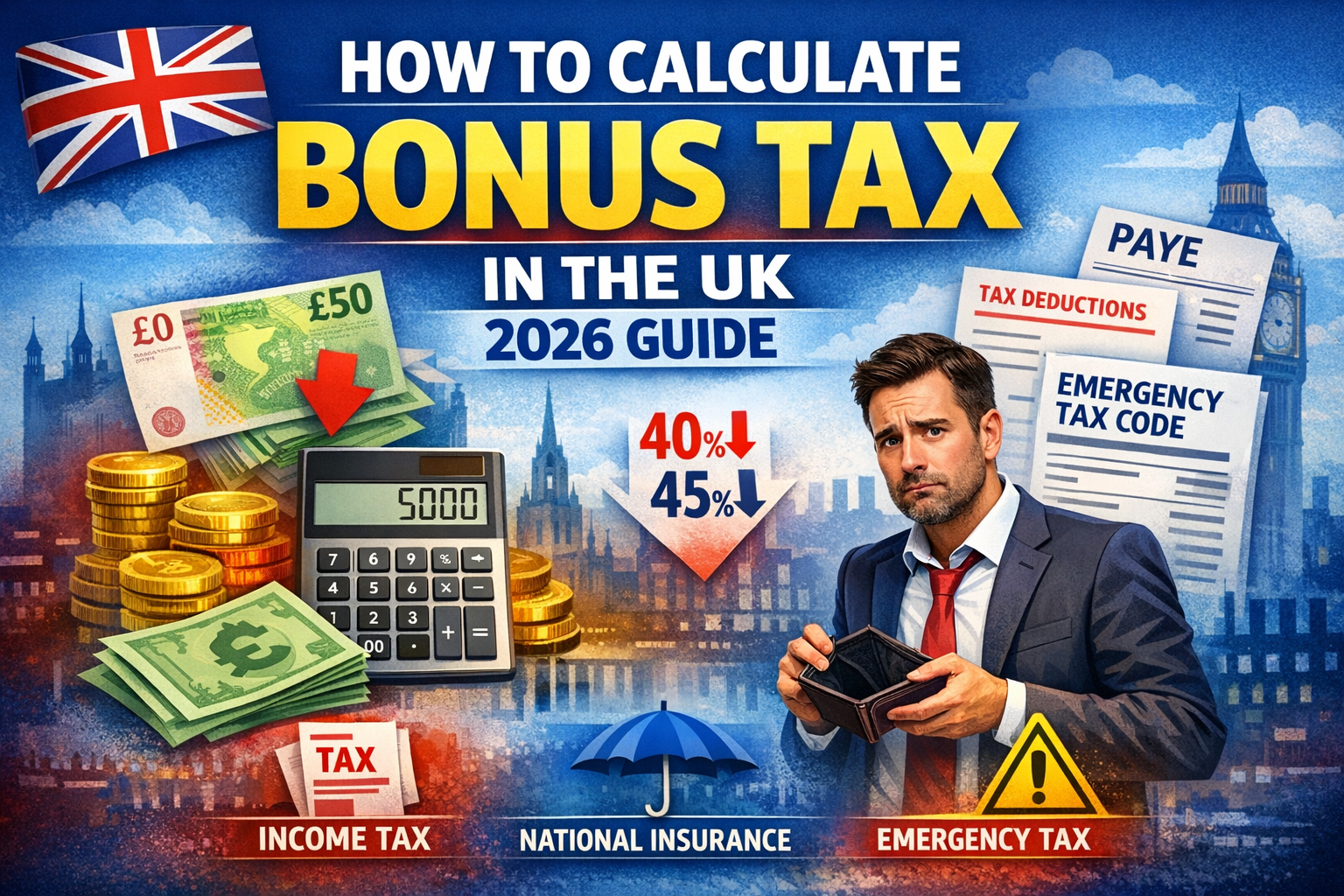
Shocking truth: Your £5,000 bonus might only add £3,000 to your bank account. Many UK workers are stunned when they see how much tax comes out of their bonus payment. If you’ve ever wondered why your bonus seems so heavily taxed or how emergency tax codes affect your take-home amount, this guide explains everything you need to know about bonus taxation in the UK for 2026.
How Bonuses Are Taxed in the UK
Let me start with the fundamental principle that catches many people off guard: bonuses are not taxed separately from your regular income. They’re treated as normal earnings and added to your annual salary for tax purposes.
This means your bonus goes through exactly the same PAYE (Pay As You Earn) system as your regular wages, with the same Income Tax and National Insurance rates applying. There’s no special “bonus tax rate” in the UK, despite how it might feel when you see your payslip.
The Core Principle
When your employer processes your bonus, they calculate tax as if you’re earning that combined salary plus bonus amount all year round. This is what often creates the shock factor because your bonus typically gets taxed at your highest marginal rate.
If your regular salary already uses up your tax-free Personal Allowance and basic rate band, your entire bonus might be taxed at 40% (higher rate) or even 45% (additional rate), plus 2% National Insurance. This is why it feels like you’re losing nearly half your bonus to tax.
Types of Bonuses That Are Taxed
All cash bonuses are taxable, regardless of what they’re called or when they’re paid:
- Annual performance bonuses: End-of-year rewards based on your performance
- Christmas bonuses: Despite the festive name, fully taxable
- Sales commission: Whether regular or one-off payments (learn more about calculating commission)
- Signing bonuses: When joining a new company
- Retention bonuses: Payments to keep you from leaving
- Discretionary bonuses: Ad-hoc payments from your employer
💡 What About Non-Cash Bonuses?
Non-cash benefits like company shares, vouchers, or prizes are also taxable but calculated differently. They’re treated as “benefits in kind” and usually result in an adjustment to your tax code rather than an immediate deduction. Cash bonuses, which this guide focuses on, are taxed through PAYE when you receive them.
Basic Bonus Tax Calculation
Understanding how your bonus tax is calculated helps demystify those shocking payslip deductions. Here’s the step-by-step process your payroll department follows.
Step 1: Add Bonus to Annual Income
Your bonus is added to your annual salary to determine your total taxable income for the year:
Total Taxable Income
Example: £35,000 + £5,000 = £40,000 total income
Step 2: Apply Tax Bands
The UK operates a progressive tax system with different rates for different income levels in 2026/27:
| Income Band | Tax Rate | Annual Earnings |
|---|---|---|
| Personal Allowance | 0% | Up to £12,570 |
| Basic Rate | 20% | £12,571 to £50,270 |
| Higher Rate | 40% | £50,271 to £125,140 |
| Additional Rate | 45% | Over £125,140 |
Step 3: Calculate Tax on Your Bonus
The clever bit: your payroll calculates the tax on your total income, then subtracts the tax you’ve already paid on your salary to date. The difference is what gets deducted from your bonus.
💼 Example: Sarah’s £5,000 Bonus
Situation: Sarah earns £35,000 per year and receives a £5,000 bonus in December.
Without bonus:
Tax on £35,000 = (£35,000 – £12,570) × 20% = £4,486 per year
With bonus:
Tax on £40,000 = (£40,000 – £12,570) × 20% = £5,486 per year
Tax on bonus:
£5,486 – £4,486 = £1,000
Sarah pays £1,000 income tax on her £5,000 bonus (20% rate)
Why Your Bonus Seems So Heavily Taxed
This is where the shock factor kicks in. If you’re earning a decent salary, your bonus often gets taxed at your highest marginal rate because your regular earnings have already used up the lower tax bands.
The Threshold Crossing Problem
The real sting comes when your bonus pushes you into a higher tax band. This is particularly painful at the £50,270 threshold where tax jumps from 20% to 40%.
💼 Example: James’s Higher Rate Shock
Situation: James earns £45,000 and receives a £10,000 bonus.
Analysis:
His salary uses up £12,570 (Personal Allowance) + £32,430 = basic rate band
Remaining basic rate: £50,270 – £45,000 = £5,270
Bonus taxation:
First £5,270 of bonus taxed at 20% = £1,054
Remaining £4,730 taxed at 40% = £1,892
Total income tax on bonus: £2,946
James loses nearly 30% of his bonus to income tax alone, plus National Insurance on top. It feels punitive, but it’s the progressive tax system working as designed.
The Personal Allowance Taper
There’s an even more brutal scenario for high earners. Once your total income exceeds £100,000, you start losing your Personal Allowance at a rate of £1 for every £2 you earn above this threshold.
This creates an effective tax rate of 60% on income between £100,000 and £125,140. If your bonus pushes you into this zone, you’ll lose a shocking percentage to tax.
If you earn £98,000 and get a £5,000 bonus, you’ll cross into the Personal Allowance taper zone. Not only is the portion above £100,000 taxed at 40%, but you’re also losing Personal Allowance, creating that eye-watering 60% effective rate on £3,000 of your bonus.
National Insurance on Bonuses
Income Tax isn’t the only deduction from your bonus. National Insurance contributions (NICs) also apply, and they work slightly differently.
NI Rates for 2026/27
Employees pay National Insurance on earnings above £12,570 per year (£242 per week or £1,048 per month):
- Standard rate: 8% on earnings between £12,570 and £50,270
- Additional rate: 2% on earnings above £50,270
The key difference from Income Tax: National Insurance is calculated on a per-pay-period basis, not cumulatively across the year. This means in the month you receive your bonus, your total earnings for that specific month are much higher, triggering NI on the full amount.
NI Calculation on Bonus Month
In the month you receive your bonus:
Monthly NI threshold = £12,570 ÷ 12 = £1,047.50
💼 Example: Emma’s NI on £3,000 Bonus
Regular monthly salary: £2,500
Bonus month: £2,500 + £3,000 = £5,500
NI calculation:
Earnings subject to standard rate: £5,500 – £1,047.50 = £4,452.50
(Stays below £4,189.17 upper threshold for 8% rate)
NI due: £4,452.50 × 8% = £356.20
Compare this to her usual monthly NI of about £116. She pays an extra £240 NI just because of the bonus timing.
Combined Tax and NI Impact
When you combine Income Tax and National Insurance, the effective deduction rate becomes clearer:
| Your Income Level | Income Tax | National Insurance | Total Deduction |
|---|---|---|---|
| Basic rate taxpayer | 20% | 8% | 28% |
| Higher rate taxpayer | 40% | 2% | 42% |
| Additional rate taxpayer | 45% | 2% | 47% |
This is why higher rate taxpayers often feel they’re losing nearly half their bonus. They literally are, once you factor in both deductions. You can explore how this compares to overall take-home pay calculations for different income levels.
Emergency Tax Codes and Your Bonus
Now we get to one of the most frustrating bonus tax scenarios: emergency tax codes. If you’re on an emergency tax code when you receive your bonus, you could be overtaxed significantly.
What Are Emergency Tax Codes?
Emergency tax codes (typically ending in W1, M1, or X) are temporary codes HMRC assigns when they don’t have complete information about your circumstances. Common situations include:
- Starting a new job without providing a P45 from your previous employer
- Starting work for the first time
- Returning to work after a long break
- Receiving company benefits or a second income
How Emergency Codes Tax Your Bonus
Emergency codes use a “non-cumulative” calculation method. Instead of looking at your total year-to-date earnings, they calculate tax based solely on that pay period’s income.
This is terrible for bonus payments because your bonus month shows a massive spike in income, and the tax system treats it as if you earn that amount every month.
💼 Example: Tom’s Emergency Code Disaster
Situation: Tom started a new job in November without a P45. His monthly salary is £3,000, and he receives a £4,000 bonus in December. He’s on emergency tax code 1257L M1.
Normal calculation: Would consider his year-to-date earnings
Emergency code calculation: Only looks at December’s £7,000 total
Tax deducted:
Monthly allowance: £12,570 ÷ 12 = £1,047.50
Taxable in December: £7,000 – £1,047.50 = £5,952.50
Tax due: £5,952.50 × 20% = £1,190.50
Tom is massively overtaxed because the system doesn’t know he’s only worked two months. He should get a refund once his tax code is corrected, but his December take-home is devastated.
Getting Your Money Back
If you’re overtaxed due to an emergency code, you have several options:
- Update your tax code: Contact HMRC or give your employer your P45. The code should correct, and future pay will adjust automatically
- Automatic refund: HMRC often sends P800 tax calculation forms after the tax year ends, showing any refund due
- Claim directly: You can claim a refund mid-year if the amount is significant
🧮 Calculate Your Exact Bonus Take-Home
Stop guessing how much you’ll actually receive. Our free calculator shows your net bonus amount after Income Tax, National Insurance, and other deductions including emergency tax scenarios.
Calculate Bonus Tax →Cumulative vs Non-Cumulative Tax Calculation
Understanding the difference between these two methods is crucial for understanding why your bonus tax might be calculated differently than expected.
Cumulative Tax Codes (Standard Method)
Most employees are on cumulative tax codes (like 1257L without W1 or M1 suffixes). This method:
- Looks at your total earnings from 6 April (start of tax year) to date
- Calculates total tax due on cumulative income
- Subtracts tax already paid
- Only deducts the difference from current payment
This is generally more accurate and fair, particularly for bonus payments, because it considers your complete earnings picture.
Non-Cumulative Tax Codes (Emergency Method)
Non-cumulative codes (ending in W1, M1, or X) calculate tax differently:
- Only looks at current pay period’s income
- Applies weekly or monthly Personal Allowance portion
- Ignores previous months completely
- Can’t make adjustments for under or overpayment
Check your payslip for your tax code. If it ends in W1 (week 1), M1 (month 1), or X, you’re on non-cumulative. If it’s just numbers and a letter (like 1257L), you’re on cumulative. Understanding your code helps you predict bonus taxation more accurately, similar to understanding PAYE deductions generally.
The Impact on Your Bonus
The calculation method dramatically affects bonus taxation:
| Scenario | Cumulative | Non-Cumulative |
|---|---|---|
| Typical bonus tax | Marginal rate only | Often higher initial deduction |
| New job bonus | Considers year-to-date | Ignores previous employment |
| Part-year worker | Pro-rates allowance correctly | Full monthly allowance each month |
| Refund likelihood | Less likely needed | Often refund due at year end |
Student Loan Deductions from Bonuses
If you have a student loan, your bonus triggers additional deductions. Student loan repayments work differently from tax but are automatically deducted through PAYE.
Student Loan Thresholds and Rates 2026/27
The repayment threshold and rate depend on which plan you’re on:
| Loan Plan | Annual Threshold | Repayment Rate |
|---|---|---|
| Plan 1 (pre-2012) | £26,900 | 9% above threshold |
| Plan 2 (post-2012) | £29,385 | 9% above threshold |
| Postgraduate Loan | £21,000 | 6% above threshold |
How Your Bonus Affects Student Loan Repayments
Student loan repayments are calculated on your total income for the year, including bonuses. The deduction from your bonus is calculated similarly to tax:
Student Loan Deduction from Bonus
Total annual income with bonus – Threshold = Repayable amount
Repayable amount × Repayment rate = Total annual repayment
Total annual repayment – Repayments already made = Bonus month deduction
💼 Example: Lisa’s Student Loan on Bonus
Situation: Lisa earns £35,000 and receives a £5,000 bonus. She’s on Plan 2.
Without bonus:
£35,000 – £29,385 = £5,615 above threshold
Annual repayment: £5,615 × 9% = £505.35
With bonus:
£40,000 – £29,385 = £10,615 above threshold
Annual repayment: £10,615 × 9% = £955.35
Extra deduction from bonus:
£955.35 – £505.35 = £450
Lisa loses an additional £450 from her bonus to student loan repayments on top of tax and NI. Learn more about student loan repayments and how they work across different income scenarios.
Pension Contributions and Bonuses
Your workplace pension contributions can either increase or decrease when you receive a bonus, depending on your pension scheme’s rules and whether you’re using salary sacrifice.
Does Your Pension Include Bonus?
Check your pension scheme rules. Some employers calculate pension contributions on:
- Basic salary only: Your bonus doesn’t trigger additional pension contributions
- Basic salary plus bonuses: Your pension percentage applies to your total earnings including bonuses
- Qualifying earnings: Contributions on earnings between £6,240 and £50,270 (includes bonuses within this band)
Salary Sacrifice and Bonuses
If you use salary sacrifice for pension contributions, you can potentially reduce tax on your bonus significantly. With salary sacrifice:
- You agree to receive less gross pay in exchange for an employer pension contribution
- This reduces your taxable income before tax is calculated
- You save both Income Tax and National Insurance
💼 Example: Michael’s Salary Sacrifice Strategy
Situation: Michael earns £55,000 and receives a £10,000 bonus. He’s a higher rate taxpayer.
Option 1: Take bonus as normal
Income Tax on bonus: £10,000 × 40% = £4,000
NI on bonus: £10,000 × 2% = £200
Take-home: £5,800
Option 2: Salary sacrifice into pension
Sacrifice entire £10,000 bonus into pension
Income Tax saved: £4,000
NI saved: £200
Total in pension: £10,000 (employer contribution)
Plus tax relief: Could claim additional 20% = £2,000
Michael’s pension grows by up to £12,000 instead of getting £5,800 cash. The trade-off is he can’t access it until retirement age. Use our pension calculator to model different contribution scenarios.
Can You Reduce Tax on Your Bonus?
While you can’t avoid paying tax on your bonus (that would be illegal), there are legitimate strategies to reduce your liability or maximize the value you receive.
Legal Tax Reduction Strategies
1. Salary Sacrifice into Pension
As discussed above, this is the most effective legal method. You reduce taxable income before PAYE is applied, saving both Income Tax and National Insurance. The catch is your money is locked away until retirement (usually age 55 or 57, depending on when you were born).
2. Timing Your Bonus Across Tax Years
If you have control over when your bonus is paid, consider the timing:
- If you’re getting a large pay rise next April, take your bonus before then (taxed at current lower rate)
- If your income will drop (perhaps going part-time), delay the bonus if possible
- Consider splitting large bonuses across two tax years to avoid threshold jumps
3. Gift Aid Donations
Charitable donations through Gift Aid can extend your basic rate tax band. If you donate £1,000, you can treat an extra £1,250 as basic rate income instead of higher rate (the £250 difference is the tax relief). This doesn’t reduce overall tax paid but shifts some higher rate tax to basic rate.
You might encounter schemes claiming to eliminate or drastically reduce tax on bonuses through complex structures like employer-financed retirement benefit schemes (EFRBS) or loans. HMRC actively challenges these arrangements. If something sounds too good to be true (like paying 0% tax on a £50,000 bonus), it probably is. Stick to legitimate, HMRC-approved methods.
Negotiating Alternatives to Cash Bonuses
Sometimes the most tax-efficient bonus isn’t cash at all. Consider negotiating for:
- Additional holiday days: Tax-free time off instead of taxed cash
- Training and development: Employer-paid courses and qualifications
- Childcare vouchers: If your employer still offers the closed scheme (tax-efficient up to limits)
- Cycle to Work scheme: Get a bike tax-efficiently
- Electric car scheme: Very low Benefit in Kind rates on electric vehicles
When considering job offers with bonuses, it’s worth using a job comparison tool to see the true post-tax value of different compensation packages.
🎯 Key Takeaways
- Bonuses are regular income: No special bonus tax rate exists; they’re taxed through normal PAYE
- Marginal rate impact: Your bonus is typically taxed at your highest marginal rate (20%, 40%, or 45%)
- National Insurance applies: Add 8% or 2% NI on top of Income Tax, calculated on bonus month earnings
- Emergency codes hurt: Non-cumulative tax codes can cause massive overtaxation on bonuses (but it’s refundable)
- Threshold crossing: Bonuses pushing you from 20% to 40% band are especially painful
- Student loans deduct too: Plan 1 and Plan 2 loans take 9% above threshold; Postgraduate 6%
- Pension salary sacrifice works: Most effective legal method to reduce tax, saving up to 42% for higher rate taxpayers
- Cumulative is better: Cumulative tax codes give more accurate bonus taxation than non-cumulative emergency codes
Frequently Asked Questions
If your salary plus bonus total exceeds £50,270, the portion above this threshold is taxed at the higher rate of 40%. Even though your salary alone keeps you in the basic rate band, your bonus can push part of your total income into the higher rate band. This is how the progressive tax system works – different portions of your income are taxed at different rates.
Yes, if you’re overtaxed (particularly common with emergency tax codes), HMRC will typically send you a P800 tax calculation after the tax year ends showing any refund due. This usually happens between June and October following the tax year. Alternatively, once your tax code corrects to cumulative, future pay will automatically adjust to recover overpaid tax. For large amounts, you can claim a refund mid-year directly from HMRC.
The main legitimate option is salary sacrifice into your pension, which must be set up before the bonus is paid. Your employer could also offer non-cash alternatives like additional holiday, training, or benefits with favorable tax treatment. However, once a cash bonus is agreed and paid, there’s no way to retrospectively make it more tax-efficient. Any schemes claiming to eliminate bonus tax through complex arrangements are likely challenged by HMRC.
Yes, Scotland has different Income Tax rates and bands from the rest of the UK. Scottish taxpayers have six tax bands including starter (19%), basic (20%), and intermediate (21%) rates, with the higher rate threshold starting at £43,662 instead of £50,270. National Insurance rates are the same across the UK, but your Scottish bonus taxation could differ significantly from an equivalent English taxpayer. Check your tax code – it should start with ‘S’ if you’re a Scottish taxpayer.
No, the total tax paid is the same regardless of how frequently bonuses are paid, assuming you’re on a cumulative tax code. The system calculates tax on your total year-to-date income. Whether you get £12,000 as one annual payment or £1,000 monthly, you’ll pay the same total tax over the year. However, monthly payments might feel less painful because the deductions are spread out and less noticeable. This is similar to understanding how salary increases affect your take-home across different payment frequencies.
From HMRC’s perspective, there’s no difference. Both are treated as regular earnings and taxed through PAYE using exactly the same rules. Whether your employer calls it a bonus, commission, or incentive payment, it’s taxable income subject to Income Tax and National Insurance at your normal rates. The terminology might matter for your employment contract or pension scheme calculations, but for tax purposes, they’re identical.
💼 Calculate Your Exact Bonus Take-Home
See precisely how much of your bonus you’ll keep after Income Tax, National Insurance, student loans, and pension contributions. Our calculator handles emergency tax codes and all deduction scenarios.
Calculate Now →🔗 Related UK Tax and Pay Tools
- → Take-Home Pay Calculator – Calculate net salary after all deductions
- → Commission Calculator – Calculate tax on sales commission
- → PAYE Tax Breakdown – Detailed PAYE and NI calculations
- → Tax Code Checker – Verify your tax code is correct
- → Student Loan Calculator – Calculate loan repayments on all income
- → Pension Calculator – Model salary sacrifice scenarios
- → View All Free Tools – Complete UK employment calculator suite