How to Calculate Maternity Pay in the UK 2026
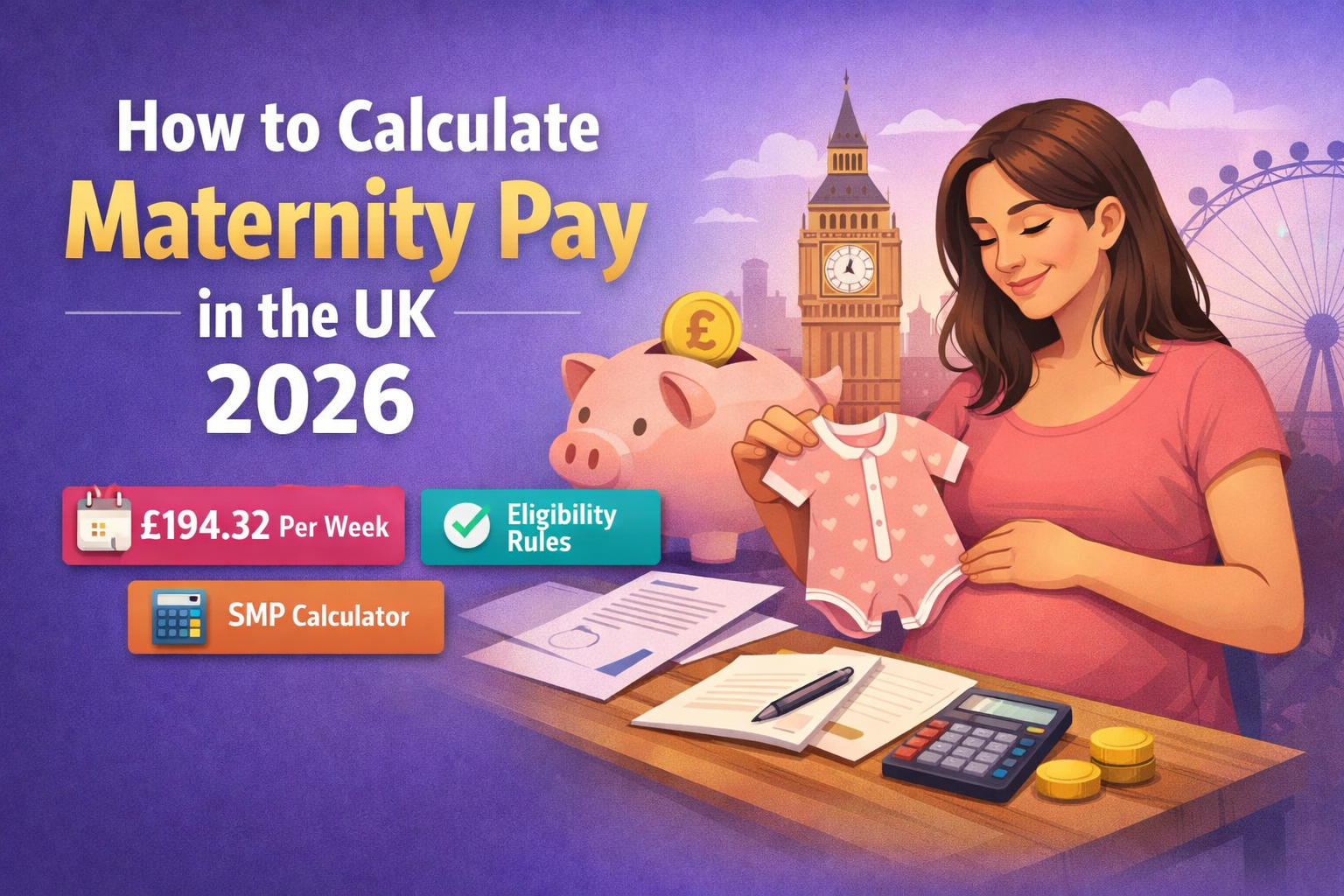
Planning for a baby? Understanding your maternity pay entitlement is one of the most important financial preparations you can make. From April 2026, Statutory Maternity Pay increases to £194.32 per week, but the calculation process can be confusing. Whether you’re entitled to basic statutory pay or enhanced company benefits, knowing exactly what you’ll receive and when helps you plan your finances during this life-changing time.
What is Statutory Maternity Pay (SMP)?
Statutory Maternity Pay is the minimum amount UK employers must legally pay eligible employees who are pregnant or have recently given birth. It’s your baseline entitlement the safety net that ensures you receive some income while you’re off work caring for your new baby.
SMP is paid for up to 39 weeks and consists of two distinct payment periods with different rates. Think of it as income protection that recognizes both your recent earnings and the reality that caring for a newborn requires extended time away from work.
The Legal Framework
Your right to SMP comes from the Social Security Contributions and Benefits Act 1992, updated regularly through Employment Rights legislation. These protections apply across England, Scotland, Wales, and Northern Ireland, ensuring consistent rights regardless of where you work in the UK.
Importantly, SMP is different from maternity leave. You’re entitled to up to 52 weeks of maternity leave (one full year), but statutory pay only covers the first 39 weeks. The remaining 13 weeks are unpaid unless your employer offers enhanced benefits.
SMP is paid by your employer, not the government directly. However, most employers can reclaim 92-103% of what they pay you from HMRC, depending on their size. This means there’s minimal financial burden on businesses to provide your statutory entitlement.
Who Pays Statutory Maternity Pay?
Your employer is responsible for paying SMP directly through your regular payroll, just like your normal wages. This continues even if you don’t plan to return to work after your maternity leave ends you’re still entitled to receive every penny of your statutory pay.
Am I Eligible for Maternity Pay?
Not every pregnant worker qualifies for SMP, but the eligibility rules are more straightforward than many people realize. You need to meet three main conditions.
The Three Eligibility Tests
Test 1: Employment Status
You must be legally classed as an “employee,” not a worker or self-employed person. If you have an employment contract, receive payslips, and have tax deducted through PAYE, you’re almost certainly an employee.
Test 2: Length of Service
You must have worked continuously for your employer for at least 26 weeks by the end of your “qualifying week” (the 15th week before your baby’s due date). We’ll explain qualifying weeks in detail shortly, but for now, know that you need roughly 6 months of continuous employment.
Test 3: Minimum Earnings
From April 2026, your average weekly earnings must be at least £129 per week (increased from £125). This is calculated over an 8-week period before your qualifying week ends.
💼 Example: Sophie’s Eligibility Check
Sophie started her job on 15 January 2026. Her baby is due on 10 October 2026.
Her qualifying week: Runs from Sunday 29 June to Saturday 5 July 2026 (15 weeks before her due date)
Has she worked 26 weeks? Yes from 15 January to 5 July is 24 weeks… wait, that’s not quite 26 weeks!
Result: Sophie would fall slightly short. Her qualifying week would need to end on 19 July or later to have completed 26 weeks of service.
What If I Don’t Qualify for SMP?
Don’t panic. If you fail any of the three SMP tests, you may still qualify for Maternity Allowance a similar benefit paid directly by the government rather than your employer. We’ll cover this in detail later in this guide.
“I’m on probation, so I don’t get maternity pay.”
Wrong! Probation periods are irrelevant to SMP eligibility. If you meet the 26-week service requirement and earnings threshold, you qualify regardless of whether you’re still technically on probation.
2026 Maternity Pay Rates
From 6 April 2026, the SMP rates have increased in line with inflation. Here’s what you need to know about how much you’ll actually receive.
The Two-Tier Payment Structure
| Payment Period | Rate | Duration |
|---|---|---|
| First 6 weeks | 90% of your average weekly earnings (no upper limit) |
Weeks 1-6 |
| Remaining 33 weeks | £194.32 per week OR 90% of average weekly earnings (whichever is lower) |
Weeks 7-39 |
The first six weeks at 90% of your earnings are designed to soften the financial impact of suddenly losing your full salary. After that, the rate drops to a flat amount unless you’re a lower earner, in which case you continue receiving 90% of your average pay.
Quick Calculation: What Will You Receive?
If your average weekly earnings are £500:
Weeks 7-39: £194.32 per week (lower than 90% of earnings)
If your average weekly earnings are £180:
Weeks 7-39: £162 per week (90% is lower than £194.32)
How 2026 Rates Compare
The £194.32 weekly rate represents a 3.8% increase from the 2025/26 rate of £187.18, reflecting inflation measured by the Consumer Price Index (CPI) in September 2025.
💷 What This Means in Practice
Over the full 39-week maternity pay period, someone earning £30,000 per year (roughly £577 per week) would receive:
- First 6 weeks: £519.30 per week (90% of £577) = £3,115.80 total
- Next 33 weeks: £194.32 per week = £6,412.56 total
- Grand total: £9,528.36 over 39 weeks
That’s approximately 55% of your normal gross annual salary for nine months of leave.
How to Calculate Your Maternity Pay
Calculating your SMP involves several steps, but once you understand the process, it becomes manageable. Your employer should do this automatically, but it’s wise to verify their calculations yourself.
Step 1: Identify Your Qualifying Week
Your qualifying week begins on the Sunday of the 15th week before your baby’s expected due date. Everything else hinges on this date, so getting it right is crucial.
Finding Your Qualifying Week
1. Take your due date
2. Count back 15 weeks
3. Find the Sunday in that week
4. Your qualifying week runs Sunday to Saturday
💼 Example: Emma’s Qualifying Week
Due date: Wednesday, 14 January 2027
15 weeks before: Wednesday, 1 October 2026
Find the Sunday: The week containing 1 October starts on Sunday, 28 September 2026
Emma’s qualifying week: 28 September – 4 October 2026
Step 2: Determine Your Relevant Period
Your “relevant period” is the time frame used to calculate your average weekly earnings. This period ends on the last payday before the end of your qualifying week.
If you’re paid weekly: The relevant period is the 8 weeks up to and including your last payday before the qualifying week ends.
If you’re paid monthly: The relevant period is the 2 months up to and including your last payday before the qualifying week ends.
💼 Example: Calculating Relevant Periods
Scenario A – Weekly Paid (Emma):
Qualifying week ends: 4 October 2026
Last payday before this: Friday, 3 October 2026
Relevant period: The 8 weekly pay periods ending on or before 3 October
Scenario B – Monthly Paid (Aisha):
Qualifying week ends: 4 October 2026
Last payday before this: 30 September 2026
Relevant period: August and September 2026 (the 2 months including her last payday)
Step 3: Calculate Average Weekly Earnings
This is where the math comes in. You need to include all gross earnings that are subject to National Insurance contributions this includes bonuses, commission, overtime, and statutory payments, but excludes expenses and benefits in kind.
For weekly-paid employees:
Weekly Calculation Formula
For monthly-paid employees:
Monthly Calculation Formula
Or more simply: (Month 1 + Month 2) ÷ 2 × 12 ÷ 52
💼 Example: Aisha’s Calculation (Monthly Paid)
August 2026 gross pay: £2,500
September 2026 gross pay: £2,700 (includes £200 bonus)
Step 1: Add the two months: £2,500 + £2,700 = £5,200
Step 2: Divide by 2: £5,200 ÷ 2 = £2,600 (monthly average)
Step 3: Multiply by 12: £2,600 × 12 = £31,200 (annual equivalent)
Step 4: Divide by 52: £31,200 ÷ 52 = £600 average weekly earnings
Aisha’s SMP:
First 6 weeks: £600 × 90% = £540 per week
Next 33 weeks: £194.32 per week
Step 4: Check Eligibility Threshold
Your calculated average weekly earnings must be at least £129 per week from April 2026. If it’s below this threshold, you don’t qualify for SMP but may qualify for Maternity Allowance instead.
If you receive a pay increase during your maternity leave that would have applied during your relevant period had you been at work, your employer should recalculate your SMP to include this increase. This rule ensures you don’t lose out financially because of the timing of a pay rise.
🧮 Calculate Your Exact Maternity Pay
Skip the manual calculations. Our free maternity pay calculator works out your exact SMP entitlement using 2026 rates, handling both weekly and monthly pay patterns automatically.
Calculate My Maternity Pay →Understanding Your Qualifying Week
The qualifying week concept trips up many expecting parents, but it’s actually quite logical once you understand its purpose. This single week determines nearly everything about your maternity entitlement.
Why the Qualifying Week Matters
Your qualifying week is used to assess:
- Whether you’ve completed 26 weeks of continuous employment
- Whether your earnings meet the minimum threshold
- Which pay periods to use for calculating your average earnings
- When your maternity leave period can begin
Think of it as your eligibility “snapshot date” your situation as of this week determines your entire entitlement.
The 15-Week Rule Explained
The qualifying week falls 15 weeks before your expected week of childbirth. Why 15 weeks? Because it:
- Gives you time to notify your employer (by the end of the 15th week before your due date)
- Ensures your earnings calculation uses recent, relevant data
- Provides certainty early enough for financial planning
- Allows your employer time to arrange cover and process paperwork
Don’t confuse your qualifying week with your notification deadline. You must tell your employer about your pregnancy by the end of the 15th week before your due date, but your qualifying week is also 15 weeks before. They’re the same timeframe notification happens AT the qualifying week, not before it.
Enhanced Maternity Pay Explained
Many UK employers offer maternity pay beyond the statutory minimum. This “enhanced maternity pay” can significantly improve your financial situation during maternity leave, but it often comes with conditions.
What is Enhanced Maternity Pay?
Enhanced maternity pay is any benefit above the legal minimum SMP. There’s no standard formula each employer designs their own scheme. Common enhanced packages include:
- Full pay for extended periods: E.g., full salary for the first 12-16 weeks instead of 90% for 6 weeks
- Half pay periods: E.g., 6 weeks full pay, then 12 weeks half pay, then standard SMP
- Extended higher rates: E.g., 90% of salary for 26 weeks instead of just 6 weeks
- Additional weeks of pay: E.g., paying something for weeks 40-52 which are normally unpaid
💼 Example: Generous Enhanced Schemes
Tech Company Scheme:
• Weeks 1-18: Full salary (100%)
• Weeks 19-39: Standard SMP (£194.32/week)
• Weeks 40-52: £500 per month to support return to work
Public Sector Scheme (NHS):
• Weeks 1-8: Full pay (less SMP)
• Weeks 9-18: Half pay plus SMP
• Weeks 19-39: Standard SMP
• Weeks 40-52: Unpaid
The Repayment Trap
Here’s the catch: many enhanced maternity pay schemes include a repayment clause. If you don’t return to work after maternity leave, or if you resign within a certain period (often 3-6 months) of returning, you may have to repay some or all of the enhanced pay but not the statutory element.
Repayment clauses can only apply to pay ABOVE the statutory minimum. Your employer cannot ask you to repay the SMP portion that’s protected by law. Always get clarification in writing about exactly what you’d need to repay if you don’t return.
How to Find Your Enhanced Pay Terms
Check these documents in order:
- Your employment contract (look for “maternity provisions” or “family leave”)
- Your employee handbook or HR policies
- Your company intranet or benefits portal
- Ask HR directly they must provide this information in writing
Maternity Allowance: The Alternative
If you don’t qualify for SMP perhaps you’re self-employed, haven’t worked long enough for one employer, or your earnings are too low Maternity Allowance (MA) might be available instead.
Maternity Allowance Eligibility
You may qualify for MA if:
- You’ve been employed or self-employed for at least 26 weeks in the 66 weeks before your due date
- You earned at least £30 per week on average in any 13 weeks of that 66-week period
Notice how this is more flexible than SMP you don’t need 26 continuous weeks with one employer, just 26 weeks of work overall in a longer time frame.
Maternity Allowance Rates (2026)
| Employment Status | Weekly Rate | Duration |
|---|---|---|
| Employed/Self-employed meeting full conditions | £194.32 or 90% of earnings (whichever is lower) | Up to 39 weeks |
| Self-employed with insufficient NI contributions | £27 per week | Up to 39 weeks |
Unlike SMP, Maternity Allowance is paid directly by the government through Jobcentre Plus or your local Jobs & Benefits office, not through your employer.
1. Apply online at GOV.UK or get form MA1 from Jobcentre Plus
2. You can claim from 26 weeks pregnant onwards
3. Provide your MATB1 certificate (from your midwife/doctor at 20 weeks)
4. Include evidence of employment/self-employment
5. Processing takes up to 8 weeks, so don’t delay
When Will I Get Paid?
Understanding the timing of maternity payments helps avoid financial surprises during what’s already a busy time.
SMP Payment Schedule
SMP is paid on your normal payday through your regular payroll. If you’re usually paid monthly on the 25th, you’ll continue receiving payment on the 25th of each month. If you’re paid weekly every Friday, your SMP arrives every Friday.
Payments are subject to normal deductions:
- Income Tax: SMP is taxable income (though at reduced pay, you may pay less tax or none at all)
- National Insurance: Deducted if your SMP exceeds the NI threshold
- Pension contributions: Depends on your scheme rules (some pause, others continue)
- Student loan repayments: Deducted if your maternity pay exceeds repayment thresholds
If you start maternity leave mid-tax-year and your total annual income falls below your personal allowance (£12,570 for 2026/27), you may be due a tax refund. Check your tax code or use HMRC’s calculator to see if you’re owed money back.
When Can Maternity Leave Start?
You can choose when to start your maternity leave, but it cannot begin before the 11th week before your due date (though you can start anytime from then until after birth).
SMP starts when your maternity leave starts, with one exception: if your baby arrives early before your planned start date, SMP automatically begins the day after birth.
Returning to Work and Repayment Clauses
Deciding whether to return to work after maternity leave involves many factors, including potential repayment obligations if your employer offers enhanced pay.
Your Rights When Returning
You have the right to return to:
- The same job if returning within 26 weeks (Ordinary Maternity Leave)
- The same job or a suitable alternative if returning between 26-52 weeks (Additional Maternity Leave)
- The same terms and conditions, including any pay rises you’d have received
If your employer refuses to let you return to your job, this may constitute pregnancy/maternity discrimination, and you may have grounds for a tribunal claim.
Enhanced Pay Repayment Terms
Repayment clauses typically work like this:
- You must return for a minimum period (often 3 months)
- If you resign before this period ends, you repay the enhanced portion only
- Repayment is usually deducted from final salary and unused holiday pay
- SMP cannot be reclaimed only contractual enhancements
If you’re considering not returning, calculate the repayment amount carefully. Compare this against potential earnings in a new job. Sometimes it’s financially better to return for the minimum period before resigning, avoiding repayment altogether.
Redundancy During Maternity Leave
If redundancies occur while you’re on maternity leave, you have priority rights to suitable alternative employment within the organization. If you’re made redundant, you’re entitled to your full redundancy pay plus any remaining SMP. Learn more with our redundancy pay calculator.
🎯 Key Takeaways
- 2026 SMP rates: 90% of earnings for 6 weeks, then £194.32/week (or 90% if lower) for 33 weeks
- Eligibility requirements: 26 weeks continuous employment by qualifying week + minimum £129/week earnings
- Qualifying week: The 15th week before your due date this determines everything
- Calculation method: Based on 8-week (weekly pay) or 2-month (monthly pay) average before qualifying week
- Enhanced pay: Many employers offer more generous terms, but watch for repayment clauses
- Maternity Allowance: Available if you don’t qualify for SMP paid by government instead
- Payment timing: Paid through normal payroll on regular payday, subject to tax and NI
- Protected rights: Cannot be forced to repay statutory SMP, even if you don’t return to work
Frequently Asked Questions
You can work up to 10 “Keeping in Touch” (KIT) days during maternity leave without losing SMP. These allow you to attend training, meetings, or do project work. Your employer must pay you at least your normal rate for KIT days, which is in addition to your SMP. Any work beyond 10 days ends your maternity leave and SMP.
Your SMP entitlement stays the same regardless of how many babies you’re having it’s calculated per pregnancy, not per baby. However, you may be entitled to additional benefits like Child Benefit for each child, and some employers offer enhanced pay for multiple births.
It depends on your pension scheme and maternity pay type. Employer contributions usually continue based on your normal salary during any period you receive maternity pay (including zero pay weeks if you’re still on maternity leave). Your own contributions are based on actual maternity pay received. Check your specific scheme rules.
If your baby arrives before your planned maternity leave start date, your leave and SMP automatically begin the day after birth. Your total entitlement doesn’t change you still get 52 weeks leave and 39 weeks pay. The only difference is the timing starts earlier than planned.
No. Once you’ve given proper notice (at least 15 weeks before your due date), your employer cannot refuse your chosen start date, as long as it’s no earlier than 11 weeks before your due date. They also cannot refuse your return date as long as you give 8 weeks’ notice if returning early.
You’ll need to meet the 26-week service requirement with your new employer to qualify for SMP. If you don’t, you may qualify for Maternity Allowance instead, which considers all employment in the previous 66 weeks. Time your job change carefully starting a new role just before becoming pregnant can affect your SMP eligibility.
No. Each pregnancy is treated separately. If you become pregnant again soon after returning from maternity leave, you simply need to meet the eligibility criteria again (26 weeks service by the new qualifying week). Your previous maternity leave doesn’t count against you.
💰 Calculate Your Complete Maternity Entitlement
Get accurate figures for your exact situation including SMP, tax implications, and take-home amounts. Our 2026-updated calculator handles all pay patterns and gives you a full breakdown.
Calculate My Maternity Pay →🔗 Related UK Employment Tools & Guides
- → Sick Pay Calculator – Calculate statutory sick pay entitlement
- → Holiday Entitlement Calculator – Work out your annual leave rights
- → Take-Home Pay Calculator – See net salary after tax and NI
- → Unpaid Leave Impact Calculator – Understand the financial effect of unpaid time off
- → Complete Holiday Entitlement Guide – Detailed article on UK annual leave
- → Payslip Deductions Explained – Understanding what comes off your pay
- → View All Free Tools – Complete suite of UK employment calculators