Student Loan Repayment UK 2026: Plans 1, 2, 4 & 5 Explained
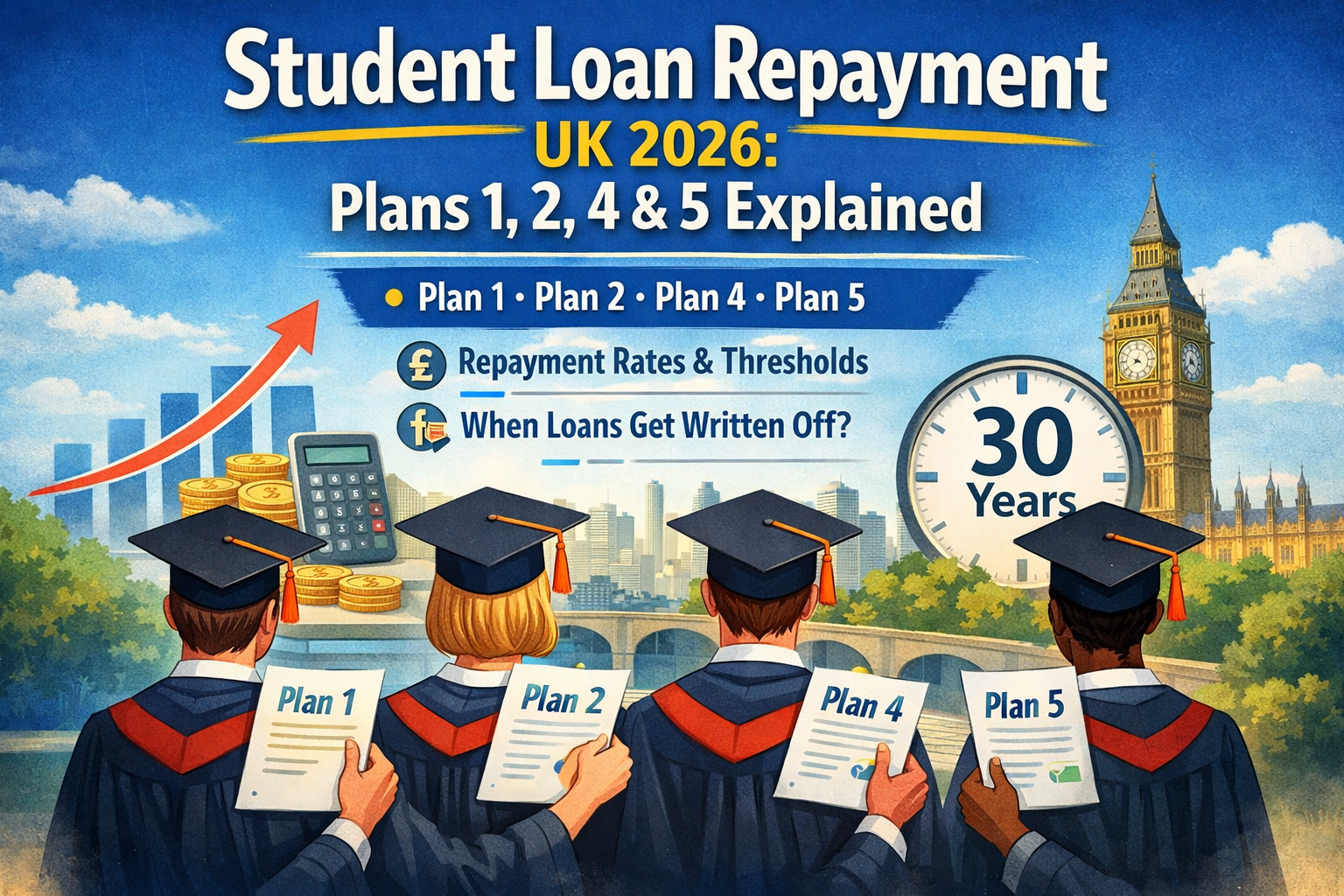
Student loan repayment confuses thousands of UK graduates every year. Between Plan 1, Plan 2, Plan 4, Plan 5, and postgraduate loans, understanding when you repay, how much comes out of your salary, and when your debt gets written off can feel overwhelming. This comprehensive guide breaks down every UK student loan plan for 2026, explains repayment thresholds, calculates what you’ll actually pay monthly, and clarifies when loans are cancelled so you know exactly where you stand.
Student Loan Repayment Thresholds 2025/26
The repayment threshold is the annual income level above which you start repaying your student loan. Earn below it? You pay nothing. Earn above it? You pay a percentage of everything above that threshold.
Here’s what you need to know: thresholds differ dramatically depending on which plan type you’re on, and they change every April.
| Plan Type | Annual Threshold 2025/26 | Monthly Equivalent | Weekly Equivalent |
|---|---|---|---|
| Plan 1 | £26,065 | £2,172 | £501 |
| Plan 2 | £28,470 | £2,372 | £547 |
| Plan 4 (Scotland) | £31,395 | £2,616 | £603 |
| Plan 5 | £25,000 | £2,083 | £481 |
| Postgraduate | £21,000 | £1,750 | £404 |
These thresholds typically increase each April in line with inflation or government policy. Plan 2 thresholds are frozen until April 2027, while Plan 1 increases annually. Always check your actual repayment amounts via your payslip or the Student Loans Company.
How Repayment Rates Work
Once you earn above your threshold, you repay:
- Plan 1, 2, 4, and 5: 9% of income above the threshold
- Postgraduate Loan: 6% of income above the threshold
Crucially, you only pay on the amount above the threshold—not your entire salary.
💼 Example: Sarah’s Plan 2 Repayment
Sarah earns £32,000 per year and is on Plan 2.
Her repayment calculation:
£32,000 – £28,470 (threshold) = £3,530 above threshold
£3,530 × 9% = £317.70 per year
£317.70 ÷ 12 = £26.48 per month
Despite earning £32k, Sarah only repays about £26 monthly because she’s only £3,530 above the threshold.
Plan 1 vs Plan 2 vs Plan 4 vs Plan 5: Key Differences
Not all student loans are created equal. Which plan you’re on depends entirely on when you started your course and where in the UK you studied.
Plan 1 (Pre-2012 Students + Scottish Students)
Plan 1 applies if you:
- Started your undergraduate course in England or Wales before September 2012
- Are a Scottish student who studied anywhere in the UK
- Are a Northern Irish student
Key features:
- Threshold: £26,065 (2025/26)
- Repayment rate: 9%
- Interest rate: RPI or 3.2%, whichever is lower
- Written off: 25 years after you were first due to repay (or at age 65, whichever comes first)
Plan 2 (2012-2023 English & Welsh Students)
Plan 2 applies if you:
- Started an undergraduate course in England or Wales between September 2012 and July 2023
Key features:
- Threshold: £28,470 (2025/26, frozen until April 2027)
- Repayment rate: 9%
- Interest rate: RPI + up to 3% (varies with income while studying, RPI after)
- Written off: 30 years after the April you were first due to repay
The Plan 2 threshold was originally set to increase annually but has been frozen at £28,470 until April 2027 as part of government policy changes. This means more graduates will be caught in repayment as salaries rise with inflation.
Plan 4 (Scottish Students)
Plan 4 applies if you:
- Are a Scottish student who studied in Scotland
- Started your course after September 1998
Key features:
- Threshold: £31,395 (2025/26) — the highest of all plans
- Repayment rate: 9%
- Interest rate: RPI (currently 3.2%)
- Written off: 30 years after the April you were first due to repay
Plan 5 (Post-2023 English Students)
Plan 5 is the newest plan type, applying if you:
- Started an undergraduate course in England on or after 1 August 2023
Key features:
- Threshold: £25,000 (2025/26) — lower than Plan 2
- Repayment rate: 9%
- Interest rate: RPI only (no additional percentage)
- Written off: 40 years after the April you were first due to repay
Plan 5 represents a significant shift in student loan policy. While interest rates are lower (RPI only vs RPI+3%), the repayment threshold is lower (£25k vs £28.47k for Plan 2), and crucially, loans aren’t written off until 40 years instead of 30. This means Plan 5 borrowers will likely repay more over their lifetime despite lower interest.
Quick Comparison Table
| Feature | Plan 1 | Plan 2 | Plan 4 | Plan 5 |
|---|---|---|---|---|
| Threshold | £26,065 | £28,470 | £31,395 | £25,000 |
| Repayment % | 9% | 9% | 9% | 9% |
| Interest | RPI (max 3.2%) | RPI + up to 3% | RPI | RPI only |
| Write-off | 25 years | 30 years | 30 years | 40 years |
How Much Will You Repay Each Month?
Your monthly repayment depends on two factors: your annual salary and which plan you’re on. Let’s look at realistic examples for each salary band.
Typical Monthly Repayments by Salary (Plan 2 Example)
| Annual Salary | Amount Above Threshold | Monthly Repayment |
|---|---|---|
| £25,000 | £0 (below threshold) | £0 |
| £30,000 | £1,530 | £11.48 |
| £35,000 | £6,530 | £48.98 |
| £40,000 | £11,530 | £86.48 |
| £50,000 | £21,530 | £161.48 |
| £60,000 | £31,530 | £236.48 |
Calculate Your Own Repayment
Example: (£35,000 – £28,470) × 9% ÷ 12 = £48.98/month
Comparing Plans at the Same Salary
Different plans mean different repayments even at identical salaries.
💼 Example: Four Graduates, Same Salary, Different Plans
All four earn £35,000 per year
Plan 1 (threshold £26,065):
(£35,000 – £26,065) × 9% ÷ 12 = £67.01/month
Plan 2 (threshold £28,470):
(£35,000 – £28,470) × 9% ÷ 12 = £48.98/month
Plan 4 (threshold £31,395):
(£35,000 – £31,395) × 9% ÷ 12 = £27.04/month
Plan 5 (threshold £25,000):
(£35,000 – £25,000) × 9% ÷ 12 = £75/month
The Plan 5 graduate pays £75/month while the Plan 4 graduate pays only £27.04—nearly three times less despite identical salaries!
🧮 Calculate Your Exact Student Loan Repayment
Stop guessing how much comes out of your salary. Our free calculator shows your exact monthly repayment based on your plan type and salary, including postgraduate loans.
Use Free Calculator →When Are Student Loans Written Off?
One of the most misunderstood aspects of UK student loans is when they’re cancelled. The good news? All UK student loans are eventually written off, regardless of how much you still owe.
Write-off Periods by Plan Type
| Plan Type | Written Off After | Counted From |
|---|---|---|
| Plan 1 | 25 years (or age 65) | April after graduation |
| Plan 2 | 30 years | April after graduation |
| Plan 4 (Scotland) | 30 years | April after graduation |
| Plan 5 | 40 years | April after graduation |
| Postgraduate | 30 years | April after graduation |
💡 What “Write-off” Actually Means
When your loan is written off:
- Any remaining balance disappears completely—you don’t owe it
- It doesn’t matter if you still owe £50 or £50,000
- There’s no tax implication or credit impact
- You simply stop making repayments and the debt vanishes
Most Graduates Won’t Repay Their Full Loan
Here’s the reality: analysis shows that approximately 70% of Plan 2 graduates will never repay their full loan amount before write-off. The combination of the repayment threshold, 9% rate, and 30-year write-off period means most people with average salaries simply won’t earn enough, long enough, to clear the balance.
💼 Example: Tom’s Loan Write-Off
Tom graduated in 2020 with £45,000 in student debt (Plan 2).
His situation:
– Average salary over career: £32,000
– Monthly repayments: £26.48 average
– Annual repayments: £317.70
Over 30 years:
He’ll repay approximately £9,531 total (ignoring salary increases and interest).
In April 2050 (30 years after first being due to repay), Tom’s remaining balance of approximately £40,000+ will be completely written off. He paid back less than £10k of his original £45k loan.
Early Write-off Circumstances
Your loan can be written off earlier than the standard period if:
- You die — loan is immediately cancelled
- You become permanently disabled and unable to work
- You reach age 65 (Plan 1 loans only, if this comes before the 25-year mark)
Postgraduate Loan Repayments
Postgraduate loans work differently from undergraduate loans, and if you have both, things get more complicated.
Postgraduate Loan Basics
Key features:
- Threshold: £21,000 (significantly lower than undergraduate thresholds)
- Repayment rate: 6% of income above threshold (vs 9% for undergraduate)
- Write-off: 30 years after April you were first due to repay
- Interest: RPI + 3%
Postgraduate vs Undergraduate Repayments
💼 Example: Emma’s Masters Loan
Emma earns £30,000 and has only a postgraduate loan.
Her repayment:
(£30,000 – £21,000) × 6% ÷ 12 = £45/month
Compare this to if it were an undergraduate loan at the £28,470 threshold and 9% rate:
(£30,000 – £28,470) × 9% ÷ 12 = £11.48/month
Emma pays four times more monthly on her postgraduate loan despite the lower percentage rate, because the threshold is so much lower.
Multiple Student Loans: How Repayment Works
Many graduates have both undergraduate and postgraduate loans. Understanding how these interact is crucial.
How Multiple Loans Are Repaid Simultaneously
If you have both undergraduate and postgraduate loans:
- Both are deducted from the same payslip each month
- Each follows its own threshold and rate
- You can end up paying both types depending on your income
Income Bands for Multiple Loans
| Your Income Level | What You Repay |
|---|---|
| Below £21,000 | Nothing |
| £21,000 – £28,470 | Postgraduate only (6%) |
| Above £28,470 | Both undergraduate (9%) + postgraduate (6%) = 15% total above undergraduate threshold |
Graduates with both loan types can end up repaying 15% of income above the undergraduate threshold (9% + 6%). On a £40,000 salary with Plan 2 + postgraduate loans, you’d pay approximately £190/month—significantly more than someone with just one loan type.
💼 Example: James’s Combined Repayments
James has both Plan 2 undergraduate and a postgraduate loan. He earns £45,000.
Postgraduate repayment:
(£45,000 – £21,000) × 6% ÷ 12 = £120/month
Undergraduate repayment (Plan 2):
(£45,000 – £28,470) × 9% ÷ 12 = £123.98/month
Total monthly deduction: £120 + £123.98 = £243.98/month
That’s £2,927.76 per year coming directly from his salary before he sees it.
Voluntary Overpayments: Should You?
Should you pay off your student loan early? The answer isn’t straightforward and depends on your financial situation and plan type.
The Case Against Overpayments (Most Graduates)
For most people, particularly on Plan 2, 4, or 5, voluntary overpayments make little financial sense:
- 70% won’t repay fully anyway — why pay extra on debt that’ll be written off?
- Opportunity cost — that money could earn returns in investments, pay off higher-interest debt (credit cards), or build an emergency fund
- No credit impact — student loans don’t affect mortgage applications or credit scores like other debts
- Interest is manageable — RPI-linked interest is far lower than most other borrowing
The Case For Overpayments (High Earners)
Overpayments might make sense if you:
- Earn significantly above threshold (£60k+) and will likely repay in full before write-off
- Are on Plan 1 with high interest rates
- Have no other debts and excess income
- Psychologically want to be “debt-free”
Should You Overpay? Quick Test
Answer these questions:
- Do you earn over £50,000 consistently?
- Will you likely repay your full loan before write-off?
- Have you maxed out pension contributions (free tax relief)?
- Do you have zero high-interest debt (credit cards, personal loans)?
- Do you have 6+ months emergency fund saved?
If you answered yes to all five, overpayments might make sense. Otherwise, your money is almost certainly better used elsewhere.
How to Make Overpayments
If you decide to overpay, you can do so via:
- Your online Student Loans Company account
- Debit/credit card
- Bank transfer
- Cheque
You can also request full early repayment by contacting the Student Loans Company directly.
Student Loans and Your Tax Code
Your student loan repayments are collected through the PAYE system, just like Income Tax and National Insurance. Your tax code tells your employer what to deduct.
Student Loan Tax Code Suffixes
When you have a student loan, your tax code includes a suffix that indicates which plan you’re on:
- No suffix or standard code — no student loan
- SL1 or 1 — Plan 1 loan
- SL2 or 2 — Plan 2 loan
- SL4 or 4 — Plan 4 loan (Scotland)
- SL5 or 5 — Plan 5 loan
- PGL or 3 — Postgraduate loan
Look at your payslip. Your tax code might read something like “1257L SL2” — this means you’re on standard tax code 1257L with a Plan 2 student loan. If your code is wrong, your repayments will be wrong too.
What If Your Tax Code Is Wrong?
Wrong tax codes cause incorrect student loan deductions. Common issues:
- Wrong plan type — repaying Plan 1 rates when you’re actually Plan 2
- No student loan marker — you’re not repaying despite earning above threshold
- Duplicate marker — repaying twice (often happens with multiple jobs)
How to fix it:
- Contact HMRC or update via your Personal Tax Account online
- Inform the Student Loans Company
- Check your next payslip confirms the change
- Claim a refund if you’ve overpaid
You can also use tools to verify your deductions are correct: Take-Home Tax Calculator or Tax Code Checker.
What Happens If You Move Abroad?
Moving overseas doesn’t cancel your student loan. In fact, failing to inform the Student Loans Company can land you in serious trouble.
Your Legal Obligations
If you leave the UK for more than 3 months, you must:
- Update your employment details with the Student Loans Company
- Provide evidence of your overseas income
- Continue making repayments if your income exceeds the UK threshold converted to local currency
Not informing the SLC when you move abroad can result in:
- Arrears building up on your account
- Penalty charges and higher repayment demands
- Legal action to recover the full loan balance
- Your loan being treated as defaulted, requiring immediate full repayment
The SLC actively tracks graduates overseas and has data-sharing agreements with many countries’ tax authorities.
Overseas Repayment Thresholds
Repayment thresholds vary by country. The SLC sets a threshold for each country based on local living costs. For example (2025/26):
- Australia: AUD 47,508 for Plan 2
- USA: USD 33,432 for Plan 2
- Canada: CAD 44,118 for Plan 2
- UAE: AED 104,766 for Plan 2
Check the exact threshold for your country on the SLC website before you move.
Making Overseas Repayments
When living abroad:
- You repay directly to the SLC (not through PAYE)
- You must provide annual income evidence (tax returns, payslips)
- Repayments can be set up as direct debit, standing order, or one-off payments
- Exchange rate fluctuations can affect your repayment amount
Returning to the UK
When you return to the UK after more than 3 months abroad:
- Update your employment details immediately with the SLC
- Your employer will resume PAYE deductions
- Any arrears built up overseas must be repaid separately
Student Loan Myths Debunked
Student loans are surrounded by misinformation. Let’s clear up the biggest myths.
Myth 1: “Student loans affect your credit score”
FALSE. Student loans do not appear on your credit report and don’t affect your credit score. Lenders can see your student loan repayments on bank statements or payslips, but the loan itself isn’t counted as a negative mark against you like credit card debt or personal loans.
However, student loan repayments do affect mortgage affordability calculations because they reduce your take-home income.
Myth 2: “You must repay immediately after graduating”
FALSE. You only start repaying the April after you finish or leave your course, and only if you’re earning above the threshold. If you graduate in July 2025, repayments don’t start until April 2026—and only if you’re earning enough by then.
Myth 3: “Interest is added while you’re studying”
TRUE… but it doesn’t matter. Yes, interest does accrue while you’re studying (RPI + 3% for Plan 2), but since most graduates never repay their full loan before write-off, the interest is largely theoretical. You only repay 9% of income above threshold regardless of the balance.
Myth 4: “You can go to prison for not repaying”
FALSE. You cannot be imprisoned for student loan debt in the UK. Student loans are “income-contingent” debts, not criminal matters. However, deliberately avoiding repayment while earning above threshold, or not informing the SLC when moving abroad, can lead to legal action to recover the money.
Myth 5: “Your children will inherit your student loan debt”
FALSE. If you die, your student loan is automatically cancelled. It is not passed to your estate, your spouse, or your children. It simply disappears.
Myth 6: “Paying off your loan early saves you thousands”
MOSTLY FALSE. For 70% of graduates who won’t repay fully before write-off, paying early means giving money to the government that you’d never have had to pay anyway. Only high earners who’ll definitely repay in full benefit from early payment—and even then, the benefit is often minimal compared to investing that money elsewhere.
Myth 7: “You can’t get a mortgage with student loans”
FALSE. You absolutely can get a mortgage with student loans. Lenders account for your repayments when calculating affordability, but student loans don’t disqualify you from borrowing. If you’re concerned about mortgage approval, use tools like the Take-Home Pay Calculator to see your true disposable income.
🎯 Key Takeaways
- Which plan matters: Plan 1, 2, 4, 5, and postgraduate loans all have different thresholds, rates, and write-off periods
- Threshold is key: You only repay 9% (or 6% for postgrad) of income above your plan’s threshold—not your entire salary
- Most won’t repay fully: Approximately 70% of Plan 2 graduates never repay their full loan before 30-year write-off
- Multiple loans = higher deductions: Undergraduate + postgraduate can mean 15% of income above threshold goes to student loans
- Moving abroad = must inform SLC: Failure to update details when leaving UK for 3+ months can result in arrears and legal action
- Overpayments rarely beneficial: For most graduates, overpaying is financially inefficient—better to use money elsewhere
- Written off eventually: All UK student loans are cancelled after 25-40 years depending on plan type
Frequently Asked Questions
Check your payslip for your tax code suffix (SL1, SL2, SL4, or SL5), log into your Student Loans Company account online, or look at your original loan agreement paperwork. Your plan depends on when you started your course and where in the UK you studied. Started before September 2012 in England/Wales? Plan 1. Started September 2012 – July 2023 in England/Wales? Plan 2. Started August 2023+ in England? Plan 5. Studied in Scotland? Plan 4.
You pay nothing. Repayments automatically stop if your income drops below your plan’s threshold. This can happen during career breaks, parental leave, job changes, or periods of unemployment. Once your income rises above the threshold again, repayments restart automatically. There’s no penalty or arrears for earning below threshold—it’s designed to protect you.
No, not in the traditional sense. Student loan repayments are income-contingent, meaning they automatically adjust based on your earnings through the PAYE system. If you earn less, you pay less (or nothing if below threshold). You can’t choose to “pause” repayments while earning above threshold. However, if you’re experiencing financial hardship, contact the Student Loans Company to discuss your options—they may be able to arrange temporary relief in exceptional circumstances.
With multiple jobs, each employer deducts student loan repayments independently based on what they pay you. This can sometimes result in over-repayment if your individual job incomes are below threshold but your combined income is above it. If you’ve overpaid, you can claim a refund via the Student Loans Company. Alternatively, complete a Self Assessment tax return to correct the repayment amounts across your jobs.
No, but they affect how much you can borrow. Mortgage lenders assess your affordability based on your take-home income after all deductions, including student loan repayments. For example, if you earn £40,000 but pay £100/month in student loans, lenders will consider your income as if it were slightly lower. This might reduce your maximum mortgage amount by £10,000-£20,000 depending on the lender’s criteria. However, student loans don’t appear on credit reports and won’t stop you being approved—they just affect the calculation. Use our Take-Home Tax Calculator to see your actual disposable income.
Yes. If you become permanently disabled to the point where you’re unable to work, you can apply to have your student loan cancelled early. You’ll need to provide medical evidence from a qualified medical practitioner confirming your permanent disability. The Student Loans Company will review your application and, if approved, write off your remaining loan balance regardless of how much you still owe. Contact the SLC directly to start this process if applicable to your situation.
When self-employed, you repay student loans through your Self Assessment tax return rather than through PAYE. You calculate your annual income, deduct the threshold, and pay 9% of the amount above threshold (or 6% for postgraduate loans). Repayments are made twice yearly with your tax payments (31 January and 31 July). You must register for Self Assessment with HMRC and declare your student loan on your tax return. If you have both employed and self-employed income, you may repay through both PAYE and Self Assessment—be careful not to overpay, as you can claim refunds but it’s administratively complex.
No. Student loan repayments are not tax-deductible in the UK. They’re deducted from your salary after tax has already been calculated and applied, similar to pension contributions but without the tax relief benefit. You cannot reduce your taxable income or claim tax relief for student loan repayments. This is different from some other countries where student loan interest may be tax-deductible.
📊 Calculate Your Student Loan Repayments Now
Get an accurate calculation for your exact plan type and salary. Our free calculator handles all plan types including Plan 1, 2, 4, 5, and postgraduate loans—plus shows combined repayments if you have multiple loans.
Calculate My Repayments →🔗 Related UK Employment Tools
- → Take-Home Tax Calculator – See your salary after tax, NI, pension, and student loans
- → Tax Code Checker – Verify your tax code includes the correct student loan marker
- → Salary Negotiation Calculator – Factor in student loan deductions when negotiating pay
- → Job Offer Comparison Tool – Compare take-home pay between offers including student loans
- → View All Free Tools – Complete suite of UK employment calculators